
Colorectal Cancer Surgery in Kolkata
Dr Mainak Pal provides assessment and surgical care for colon and rectal cancer, including colon cancer surgery in Kolkata. Depending on the tumour and stage, a minimally invasive laparoscopic or open surgery may be recommended.
Home / Treatments / GI Cancer / Colorectal Cancer Surgery
Notable Statistics:
Nearly 1.9 million people worldwide have colorectal cancer.
India has 65,000 to 70,000 new cases every year.
Studies show early detection improves recovery chances.
What Is Colorectal Cancer Surgery?
Colorectal cancer surgery removes the tumour, an appropriate margin of bowel and nearby lymph nodes. The pathology results help confirm the stage and guide further treatment.
The healthy bowel ends may be rejoined. A temporary or permanent stoma may be needed when a safe join is not possible or requires protection while healing.
Treatment at a Glance
| Treatment Detail | What to Expect |
|---|---|
| Conditions treated | Cancers of the colon and rectum |
| Main purpose | Remove the tumour and assess nearby lymph nodes |
| Surgical approach | Laparoscopic colorectal surgery in suitable cases |
| Common procedure | Colectomy—removal of part or all of the colon |
| Anaesthesia | General anaesthesia |
| Recovery | Depends on the operation, stage and overall health |
| Treatment by | Dr Mainak Pal |
Which Colorectal Procedures May Be Considered?
- Colectomy: Removal of part or all of the colon, depending on the affected area.
- Laparoscopic colorectal surgery: A minimally invasive approach used for suitable conditions.
- Colostomy: An opening created to divert bowel waste; may be required in rare cases after colectomy.
Note: Based on the tumour’s location, stage and the findings, a laparoscopic or open procedure is recommended.
When May Surgery Be Recommended?
Surgery may be considered for:
- A localised colon or rectal tumour
- A cancerous polyp not fully removed endoscopically
- Disease involving nearby lymph nodes
- Obstruction, perforation or significant bleeding
- Selected recurrent or limited metastatic disease
- Symptom relief when complete removal is not possible

Note: Rectal cancer may need chemotherapy or radiotherapy first. Advanced disease may initially require systemic treatment.
Which Symptoms Need Assessment?
- Persistent change in bowel habits
- Blood in or on the stool
- Incomplete bowel emptying or abdominal pain
- Unexplained weight loss
- Tiredness or iron-deficiency anaemia
- Vomiting or abdominal swelling

What Are the Potential Benefits of Timely Surgery?
For appropriately selected patients, surgery may support:
- Complete removal of localised disease
- Accurate staging through lymph-node assessment
- Relief of obstruction or bleeding
- Restoration of bowel continuity when feasible
- Laparoscopic surgery in suitable cases
- Further-treatment planning based on pathology
Why Choose Dr Mainak Pal for Colon and Rectal Cancer Surgery?
Dr Pal’s academic and professional background includes:
- MS in General Surgery
- FMAS from the Association of Minimal Access Surgeons of India
- Advanced laparoscopic knotting and suturing training at ETHICON, New Delhi
- Surgical experience at IPGMER and Peerless Hospital, Kolkata
- Experience in upper-GI malignancy and laparoscopic colorectal surgery
- Academic and research guidance for DNB trainees at Peerless Hospital
Have You Been Diagnosed With a Colon or Rectal Tumour?
Staging clarifies whether surgery is suitable and whether another treatment should come before or after it.
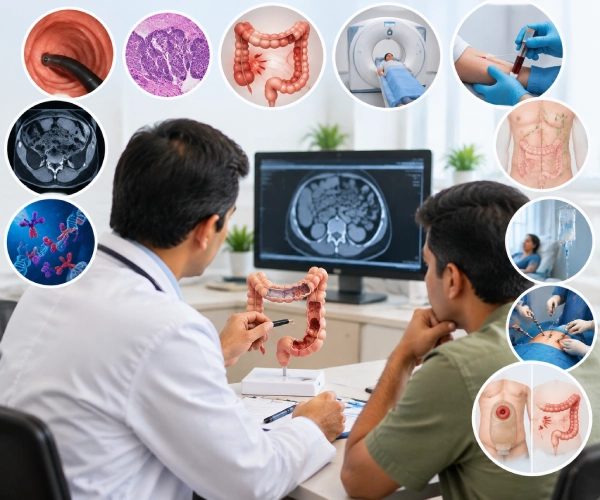
How Is Colorectal Cancer Treatment Planned?
Planning may consider:
- Colonoscopy and biopsy findings
- Tumour location, size and stage
- CT scans and pelvic MRI when indicated
- Blood tests, including CEA when appropriate
- Lymph-node or distant-organ involvement
- Tumour biomarkers when relevant
- Previous operations, general health and nutrition
- Need for chemotherapy or radiotherapy
- Suitability for laparoscopic colorectal surgery
- Possibility of reconnection or a stoma
What Happens During Colon and Rectal Cancer Surgery?
Before Surgery
- Review of biopsy, imaging and stage
- Blood tests and anaesthesia assessment
- Medication and nutrition review
- Bowel preparation when instructed
- Stoma counselling and admission guidance when relevant
During Surgery
- General anaesthesia
- Laparoscopic access in suitable cases
- Removal of the tumour-bearing bowel and nearby lymph nodes
- Joining of healthy bowel ends when safe
- Temporary or permanent stoma when required
After Surgery
- Monitoring and prescribed medicines
- Gradual return to food and movement
- Wound, drain or stoma care
- Pathology review and further-treatment planning
What Can You Expect During Recovery?
| Stage | What You May Expect |
|---|---|
| Hospital phase | Monitoring, symptom control, bowel checks and walking |
| Early home phase | Wound or stoma care, medicines and light activity |
| Return to routine | Gradual return based on recovery and work demands |
| Long term | Pathology review, oncology treatment when advised and scheduled surveillance |
What Can Happen If Colon and Rectal Malignancy Is Left Untreated?
Delay may increase the risk of:
- Bowel narrowing or complete obstruction
- Persistent bleeding and iron-deficiency anaemia
- Perforation of the bowel
- Spread to lymph nodes, the liver, lungs or abdominal lining
- Emergency surgery or a more extensive operation
- Fewer available treatment options
What Determines the Cost of Colorectal Cancer Surgery?
Cost may vary by:
- Tumour location and stage
- Investigations and pathology tests
- Selected surgical procedure
- Extent of bowel and lymph-node removal
- Anaesthesia, theatre and consumables
- Hospital or intensive-care stay
- Stoma support, medicines and follow-up care
- Insurance coverage

What People Also Ask
Is surgery required for every colorectal cancer?
No. Stage, tumour location and health guide whether another treatment is needed first.
Can colon cancer surgery be performed laparoscopically?
Yes, in suitable cases. Tumour location, previous surgery and health influence the approach.
Will a patient need permanent stoma?
Not always. This depends on tumour location, bowel condition and surgical safety.
Is chemotherapy always needed after surgery?
No. The recommendation depends on the stage, lymph-node findings, tumour features and recurrence risk.
Consult for Colon Cancer Surgery in Kolkata
Consult Dr Mainak Pal for an assessment of a confirmed or suspected colorectal tumour and to discuss suitable surgical options.
A Few Kind Words
Treatment Experiences
Here’s what the patients have to say after surgery.