
Laser Proctology in Kolkata for Piles, Fissure and Fistula
Dr Mainak Pal assesses piles, fissures and fistulas and recommends painless and minimally invasive laser proctology. Laser suitability depends on the diagnosis and disease extent.
Home / Treatments / Piles, Fissure & Fistula / Laser Proctology
Key Insights:
Nearly 26% of people worldwide are estimated to have piles.
11% of people experience anal fissures during their lifetime.
Up to 50% of anal abscesses may progress to a fistula.
What Is Laser Proctology?
Laser proctology uses controlled light energy during the treatment of selected anal conditions. Depending on the diagnosis, it may coagulate haemorrhoidal tissue or help close a suitable fistula tract.
It’s not a one-size-fits-all procedure. Suitability, technique and expected recovery differ between piles, fissures and fistulas.
Laser Proctology at a Glance
| Treatment Detail | What to Expect |
|---|---|
| Conditions assessed | Piles, anal fissure and anal fistula |
| Main purpose | Treat suitable tissue with laser energy |
| Laser piles surgery | Coagulation and shrinkage of selected haemorrhoids |
| Laser fissure | Role depends on fissure and sphincter assessment |
| Laser fistula | Closure of selected fistula tracts with a laser fibre |
| Anaesthesia | Local, spinal or general |
| Hospital stay | Day care or short stay in suitable cases |
| Recovery | Varies with the condition and procedure |
| Consultant | Dr Mainak Pal |
Which Conditions May Be Assessed for Laser Treatment?
Laser Piles Surgery
Laser energy may coagulate or shrink selected internal haemorrhoids. Grade, prolapse and external components guide suitability.
Laser Fissure Treatment
“Laser fissure” is not one standard procedure. Initial care may include fibre support, stool-softening measures, sitz baths and prescribed medicines. Lateral internal sphincterotomy may be considered when suitable medical treatment does not heal a chronic fissure. Any laser role requires clinical confirmation.
Laser Fistula Treatment
Laser fistula closure delivers energy within a mapped tract while aiming to protect the sphincter. It does not suit every fistula. Other possible procedures include fistulotomy, fistulectomy, LIFT and seton placement.
Which Symptoms Need a Proctology Assessment?
- Bright-red bleeding during bowel movements
- Anal irritation or swelling
- Discomfort while passing stool
- A visible tear near the anal opening
- Recurrent discharge or an external opening
- Tissue protruding during bowel movements
How Is the Condition Diagnosed?
Assessment may include:
- Symptoms and their duration
- Bowel habits and constipation
- Previous anal abscesses or procedures
- Inspection of the affected area
- Digital rectal examination when appropriate
- Anoscopy for selected concerns
- MRI for complex or recurrent fistulas
- Further assessment for unexplained bleeding
Note: MRI may help map a fistula’s branches and relationship with the sphincter before treatment planning.
How Is the Treatment Plan Decided?
Piles planning considers grade, prolapse and external tissue. Fissure care depends on duration, location and muscle spasm. Fistula planning reviews openings, branches, recurrence and sphincter involvement. Laser is considered only when suitable.
How Does Laser Piles Surgery Work?
Laser haemorrhoidoplasty may be considered for selected internal haemorrhoids. The procedure follows three main steps:
Laser Fibre Placement
- A fine diode laser fibre is positioned inside the haemorrhoidal cushion.
- Depending on the technique, a 980 nm or 1470 nm laser may be used.
Controlled Coagulation
- Short, controlled pulses of laser energy are delivered.
- The energy coagulates selected blood vessels.
- This reduces blood flow to the haemorrhoidal tissue.
Gradual Shrinkage
- The treated tissue begins to contract.
- Fibrosis develops as the area heals.
- Bleeding and prolapse may gradually improve.
Treatment Effect at a Glance
- Before: Enlarged vascular cushions may bleed or prolapse.
- During: Laser energy targets selected tissue from within.
- After: The haemorrhoidal tissue gradually contracts and fibroses.
Note: However, large external piles or advanced prolapse may require an additional or different procedure.
What Are the Potential Benefits of Laser Proctology?
- Controlled delivery of energy to selected tissue
- Limited external wounds in some cases
- Sphincter-preserving intent for selected fistulas
- Less early postoperative discomfort in some piles studies
- Day-care treatment may be possible
- Gradual return to routine activities
Why Choose Dr Mainak Pal for Laser Proctology?
Dr Mainak Pal’s academic and professional background includes:
- MS in General Surgery
- Fellowship in Minimal Access Surgery—FMAS
- MIPH and laser proctology training at IMMAST, Mumbai, in 2023
- Consultant experience at Peerless Hospital, Kolkata
- Coloproctology conference participation
- DNB teaching and thesis guidance
Condition-Led Procedure Selection
Treatment begins by confirming the diagnosis and extent. Laser is one possible tool within a wider plan.
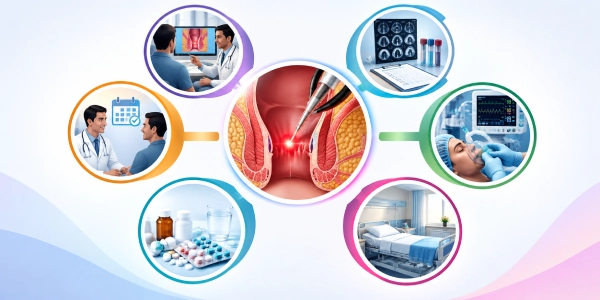
What Happens Before and After Laser Proctology?
Before Treatment
- Clinical and anaesthetic assessment
- Review of medicines and bleeding risks
- Anoscopy or imaging when required
- Bowel preparation when advised
- Fasting and admission instructions
After Treatment
- Monitoring during early recovery
- Prescribed medicines
- Checks for bleeding or discharge
- Hygiene and bowel-care guidance
- Discharge and follow-up planning
What Is the Recovery Timeline?
| Stage | What You May Expect |
|---|---|
| First 24 hours | Monitoring, symptom control and gentle movement. |
| First week | Local discomfort or mild discharge may occur. |
| 1–2 weeks | Gradual return to routine in suitable cases. |
| Following weeks | Review of healing and symptoms. |
Note: Fistula healing may require longer follow-up. Follow individual instructions.
What Care Is Needed After Treatment?
- Take prescribed medicines as advised
- Maintain adequate fibre and fluid intake
- Avoid straining and prolonged toilet sitting
- Follow hygiene and dressing instructions
- Resume activity gradually
- Attend every scheduled follow-up

What Can Happen If These Conditions Are Left Untreated?
Persistent piles, fissures or fistulas may lead to:
- Repeated bleeding or discharge
- Increasing haemorrhoidal prolapse
- A fissure becoming chronic
- Recurring muscle spasm and constipation
- Repeated fistula-related abscess formation
- Additional fistula branches or openings
- Disruption to hygiene and daily activities
What Determines the Cost of Laser Proctology?
Cost depends on:
- Diagnosis
- Investigations
- Anaesthesia
- Laser Equipment
- Hospital Stay
- Medicines and Follow-Up
What People Also Ask
Is laser suitable for every piles case?
No. Grade, prolapse and external tissue guide treatment.
Does every anal fissure need laser treatment?
No. Many begin with bowel care and medicines. Chronic fissures may require another procedure.
Can a complex fistula be treated with laser?
Possibly, but branching and sphincter involvement may favour another approach.
Can conditions return after laser treatment?
Yes. Recurrence or incomplete healing remains possible.
Is laser proctology always painless?
No. Anaesthesia, medicines and recovery care may still be needed.
Consult for Laser Proctology in Kolkata
Consult Dr Mainak Pal to determine whether laser-assisted treatment or another approach is suitable.
A Few Kind Words
Treatment Experiences
Here’s what the patients have to say after surgery.