

Bleeding during a bowel movement or a painful lump near the anus can be alarming. More importantly, sometimes it's a little tricky to figure out whether it is an internal pile, an external pile or something unrelated.
Understanding internal vs external haemorrhoids helps determine the right care. Piles and haemorrhoids describe the same condition, but their location and symptoms differ. During piles treatment, I assess the type, grade, prolapse and bleeding before recommending home care, an office procedure or surgery.
To help you make informed decisions, this blog discusses the topic in depth; please read it to the end.
What Are Haemorrhoids (Piles)?
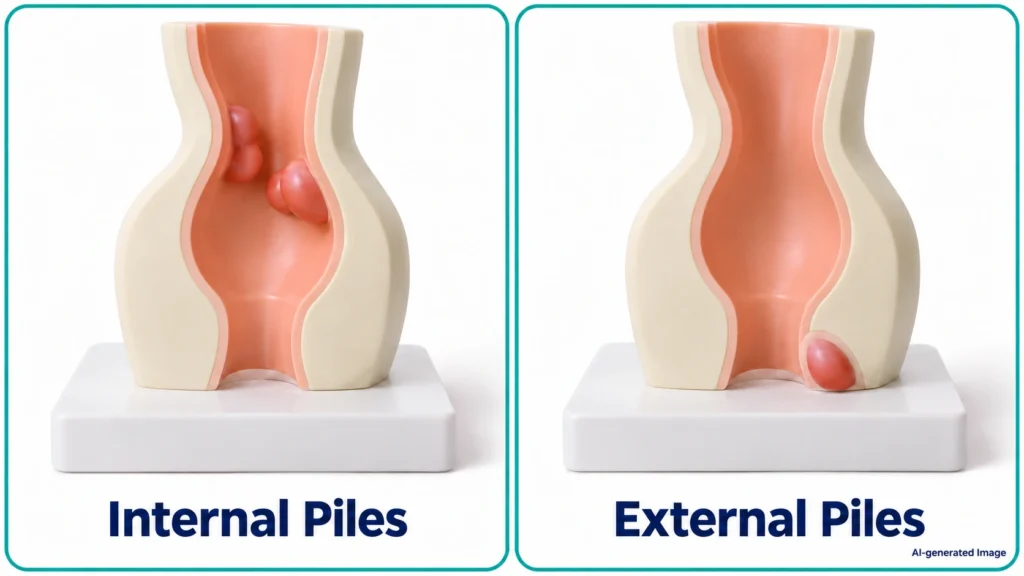
Haemorrhoids are normal vascular cushions that help the anus close. Symptoms begin when this tissue enlarges, slips down or develops a clot. Internal haemorrhoids arise inside the anal canal; external haemorrhoids form beneath the sensitive outer skin.
An examination matters before piles treatment because haemorrhoids are only one of several causes of rectal bleeding. Fissures, inflammation, polyps and colorectal conditions may also bleed.
Why Haemorrhoids Develop?
Straining, constipation, long toilet sessions, pregnancy, chronic diarrhoea and a low-fibre diet increase pressure around these cushions. Weaker supporting tissue can also allow internal piles to move downwards.
Internal vs External Haemorrhoids: Key Differences
The main difference is their position in relation to the dentate line, where the inner lining changes to sensitive outer skin.
| Feature | Internal hemorrhoids | External hemorrhoids |
| Location | Inside the anal canal | Beneath the skin around the opening |
| Pain | Often painless unless prolapsed or strangulated | Can ache, itch or become sharply painful if thrombosed |
| Bleeding | Bright-red bleeding is common | Less common unless the surface skin breaks |
| Visibility | Usually unseen unless they prolapse | May be seen or felt as a lump |
| Common symptoms | Bleeding, mucus, irritation and prolapse | Swelling, itching, tenderness and difficulty cleaning |
Internal Haemorrhoid Symptoms
Internal haemorrhoid symptoms include painless bright-red bleeding and tissue coming out during a bowel movement. Prolapsed haemorrhoids may cause mucus, itching or difficulty cleaning.
External Haemorrhoid Symptoms
External piles may itch, swell or form a lump. Pain can become sudden and intense when a clot develops.
Internal Haemorrhoid Grades (1 to 4)
The four haemorrhoid grades (Grade 1 to 4) describe internal-pile prolapse. The commonly used Goligher classification is as follows:
| Grade | What Happens |
| Grade 1 | The haemorrhoid remains inside and does not prolapse |
| Grade 2 | It comes out while passing stool but returns by itself |
| Grade 3 | It comes out and must be pushed back manually |
| Grade 4 | It remains outside and cannot be pushed back |
Bleeding, discomfort, external disease and the effect on daily life also influence treatment.
Thrombosed External Haemorrhoids: Sudden Pain Explained
A thrombosed external haemorrhoid develops when blood clots beneath the tightly attached outer skin, producing a firm lump and constant pain.
Early removal may give faster relief when pain is severe, but there is no rigid cut-off. If symptoms are already easing, warm baths, fibre and prescribed pain relief may be preferable.
Which is More Serious: Internal or External Haemorrhoids?
Neither type is usually dangerous. Seriousness depends on bleeding, prolapse, thrombosis and whether another condition is present. Pain alone can mislead: an external clot may hurt more, while an internal pile may bleed more.
When Internal Haemorrhoids Become Serious
Grade 3 or 4 prolapsed haemorrhoids may remain outside or become trapped. Repeated heavy bleeding can cause anaemia, while a strangulated prolapse needs prompt assessment.
When External Haemorrhoids Become Serious
An external thrombosis may cause unrelenting pain or skin breakdown. Fever, pus or rapidly worsening swelling needs urgent examination.
Red Flags: See a Doctor Immediately
Seek medical help for:
- heavy or persistent bleeding;
- black or tarry stool;
- dizziness, fainting or unusual weakness;
- bleeding with abdominal pain, fever, weight loss or changed bowel habits; or
- new bleeding at any age, especially from age 45, when routine colorectal cancer screening is recommended for average-risk adults. (Source)
Immediate medical care is advised when severe anal pain accompanies rectal bleeding, abdominal pain, diarrhoea or fever (Source).
How to Treat Haemorrhoids at Home?
Useful home remedies for haemorrhoids focus on easier bowel movements. Increase fibre gradually, drink enough water, avoid straining and limit toilet time. Warm sitz baths may soothe irritation. This is often the first stage of piles treatment in Kolkata.
Creams may give brief relief, but prolonged self-use can irritate the skin. Seek examination if symptoms continue for a week or bleeding occurs.
Medical Treatments for Internal Haemorrhoids
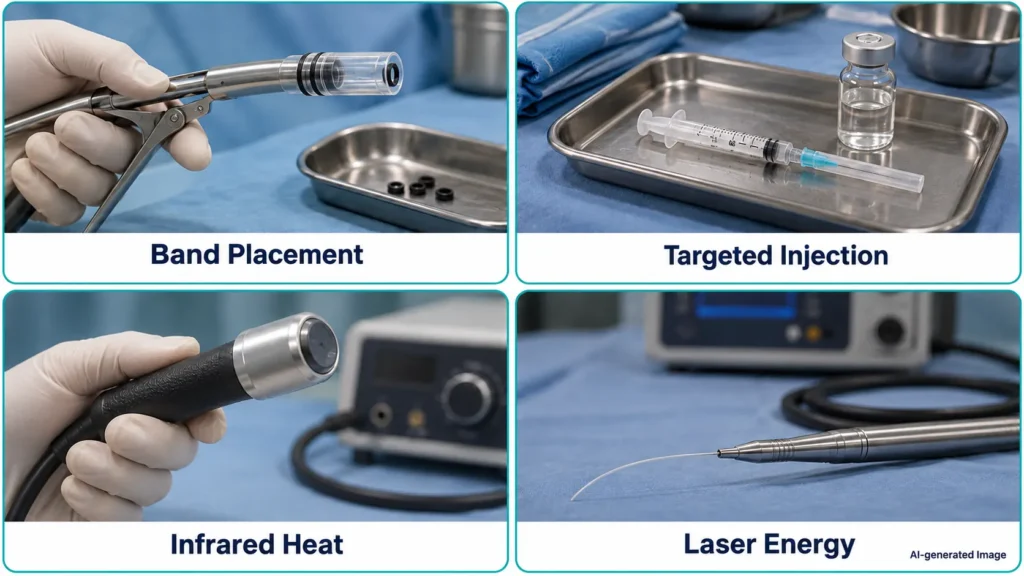
For piles treatment, I choose an approach according to the grade, bleeding, prolapse and use of blood-thinning medicines.
- Rubber band ligation: A band stops blood flow to an internal pile. It suits grades 1–2 and selected grade 3 disease—not external piles. In a study of 2,635 patients cited by ASCRS, 86.7% were symptom-free at eight weeks. Complications occurred in 22.5%, with pain being the most common, while 15.5% experienced symptomatic recurrence within two years. (Source)
- Sclerotherapy: An injected solution causes the internal haemorrhoid to scar and shrink.
- Infrared coagulation: Controlled heat reduces blood supply, mainly in grades 1–2.
- Laser treatment for piles: Laser haemorrhoidoplasty shrinks selected internal piles. A clinical study found less operative blood loss, postoperative bleeding, operating time and day-one pain than conventional hemorrhoidectomy. Urinary retention and recurrence did not differ significantly between the two groups. (Source: PubMed)
Surgery for Haemorrhoids: When is It Needed?
Surgery may be considered for large external piles, combined disease, grade 3–4 prolapse, repeated bleeding or symptoms that have not improved with office treatment.
- Hemorrhoidectomy: Removes troublesome tissue and remains effective for advanced or combined disease.
- Stapled hemorrhoidopexy: Lifts prolapsing internal tissue. ASCRS does not recommend it routinely as a first-line surgical treatment because of its risk profile and marginal effectiveness.
- Laser hemorrhoidoplasty: May suit selected internal piles, but “laser” does not automatically mean better or permanent.
After hemorrhoidectomy or piles surgery, returning to full activity may take two to four weeks.
During piles treatment, I compare the likely recovery time, possible risks and risk of recurrence before recommending a procedure.
How to Prevent Haemorrhoids from Coming Back
Use fibre and fluids, exercise, respond to bowel urges, avoid straining and limit toilet time. If haemorrhoid symptoms or bleeding return, seek reassessment because rectal bleeding can extend beyond piles.
Match the Treatment to the Type and Grade
With internal vs external haemorrhoids, neither type is always worse. An examination reveals the grade, and experts suggest whether home care, banding, another office procedure, or piles surgery is appropriate.
For piles treatment in Kolkata, book a consultation with Dr Mainak Pal based on your condition. Persistent bleeding, a painful lump or recurring prolapse deserves a clear diagnosis.
What People Also Ask
1. Which is more serious, internal or external haemorrhoids?
Neither is automatically worse. Advanced prolapse or heavy bleeding needs assessment, while an external clot can cause severe pain.
2. Can internal haemorrhoids turn into external haemorrhoids?
No. They arise in different locations, although both types can occur together.
3. How can rectal bleeding from haemorrhoids be distinguished from something more serious?
Colour alone cannot confirm the cause. Persistent or heavy bleeding, black stool, bowel changes, weight loss or anaemia need medical evaluation.
4. Do haemorrhoids go away on their own?
Mild symptoms may settle with better bowel habits, but enlarged or prolapsing tissue can become symptomatic again.
5. When is surgery needed for haemorrhoids?
Surgery may be advised for large external piles, combined disease, grade 3–4 prolapse, recurrent heavy bleeding or symptoms that have not improved with office treatment.